

Early Childhood & Kindergarten
Ages 3 – 5
A warm, thoughtfully designed environment where children grow up bilingual, build independence and curiosity, and take their first steps toward global citizenship.
Growing up at Marymount
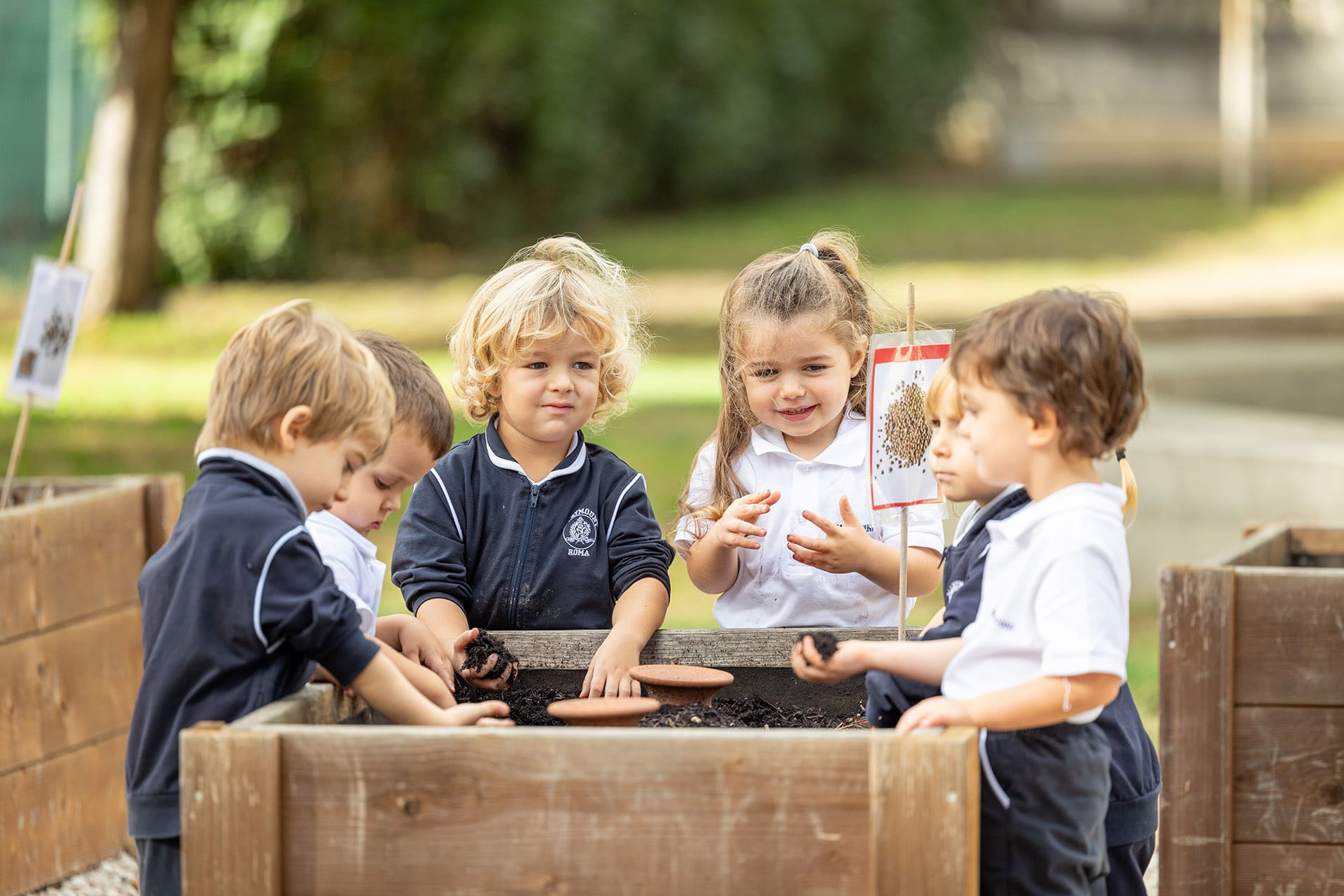
We welcome children aged 3 to 5 into a carefully designed, stimulating environment created to support balanced, serene growth and the harmonious development of every aspect of their personality. Here they build independence, curiosity and a first awareness of what it means to be a global citizen.
With native English-speaking teachers present in every class, English becomes part of children's everyday life, allowing us to offer families an open, multicultural and cosmopolitan educational experience.
We believe in an authentic partnership with families: transparency, trust and dialogue are the foundations of our approach, because a high-quality learning environment is always built on collaboration.
How our youngest learners learn
Four methodological choices, grounded in the best educational research, shape every day of our Early Childhood program.
Bilingualism
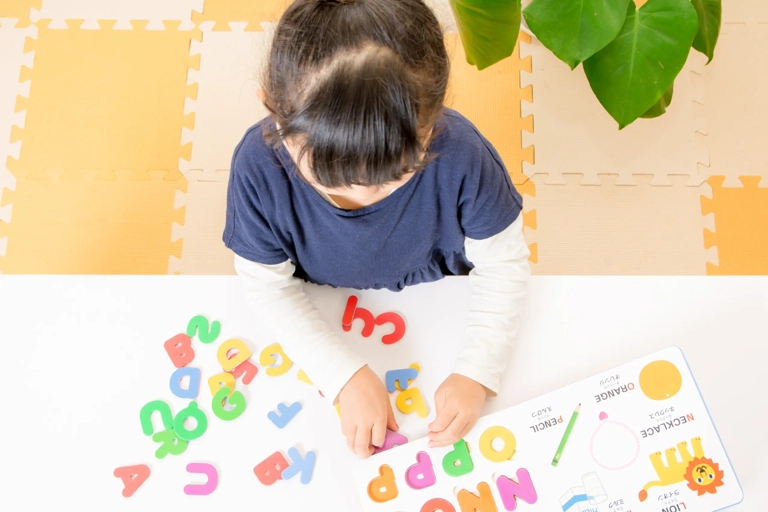
Children develop language skills in Italian and English in an integrated way: from the very start, English is the language of instruction across the curriculum, fostering cognitive flexibility, intercultural competence and deeper understanding.
Experiential learning
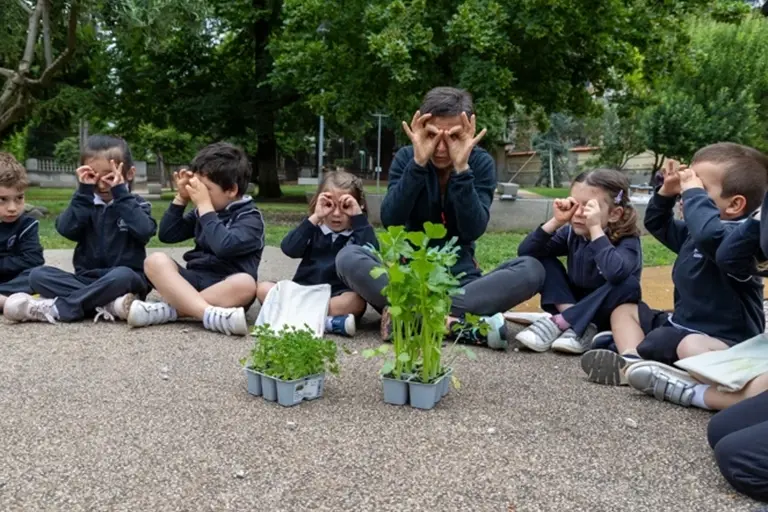
We foster learning through direct, interactive experiences that spark curiosity and discovery, while encouraging children to reflect on what they have learned and build skills such as problem solving, collaboration and independence.
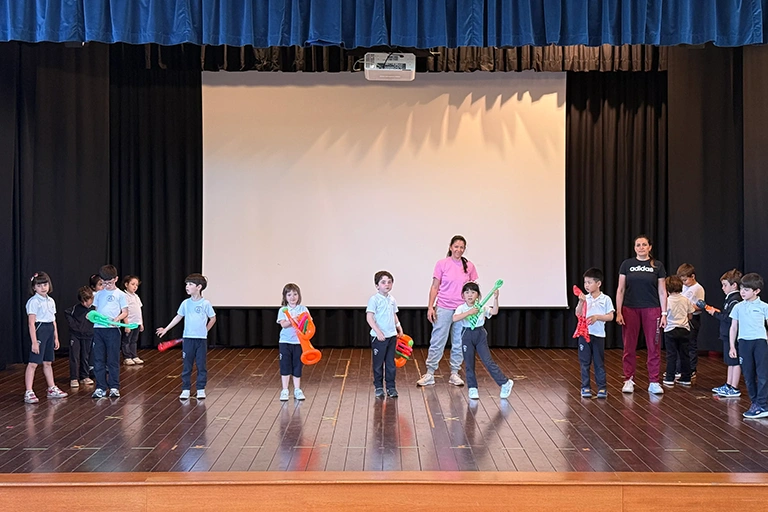
Play-based approach
Play is our primary tool for building early literacy skills; in recent years, educational robotics has also introduced children to coding and computational thinking.
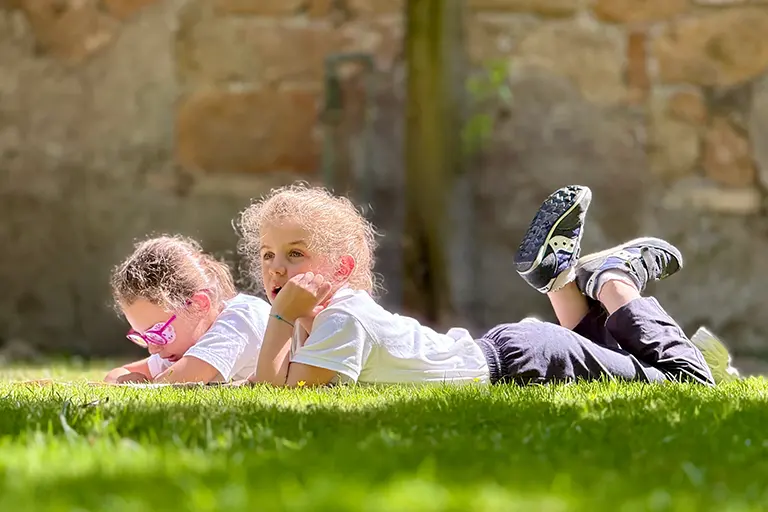
Multisensory learning
We engage all the senses through a rich variety of materials, above all through Outdoor Learning: classroom time alternates with dynamic outdoor spaces equipped with hands-on mosaic stations and learning panels.
The five fields of experience
Our educational planning is firmly rooted in the five fields of experience set out in the Italian National Guidelines for the first cycle of education. Exploring these areas, children gradually develop an awareness of their own identity, of how they perceive others, and of the similarities and differences between people, learning respect for themselves and for others.
The self and the other
Developing personal and social identity.
The body and movement
Body awareness and motor skills.
Images, sounds and colors
Creative and artistic expression.
Speech and words
Language development and communication.
Knowledge of the world
Exploration, discovery and logic.
Teachers in continuous training
Through specific, ongoing professional development, our teachers stay at the forefront of educational methodology and bring innovative approaches into the classroom: every child grows in an environment that welcomes them, challenges them and helps them feel safe as they discover what they are capable of.
A three-stage journey, without disruption
Children are grouped by age into two sections each year. Teaching is organized in parallel classes, with an annual plan aligned to the school-wide curriculum and a flexible progression that adapts to the needs we observe in the children — an essential feature of the Early Childhood day.
The children's day alternates free play with more structured activities, always with the constant co-presence of an Italian-speaking teacher and a native English-speaking teacher.
Teaching focuses on building children's self-esteem through positive experiences that help them trust their own abilities and feel confident as learners, preparing them for the challenges ahead.
For first-year children only, a gradual settling-in period is planned for the first 15 days of school, following a schedule agreed with families and communicated well in advance.
The third year of our program is called Kindergarten, in keeping with the English-speaking tradition: a year dedicated to strengthening verbal and logical-mathematical skills, designed to guide children gently toward Primary School.
Morning activities are more structured and take place in small groups. The spacious classrooms each feature a sliding partition that lets teachers create two distinct areas, one for English and one for Italian. Respecting each child's pace and learning style, the year focuses on logical-mathematical skills, pre-writing and pre-reading.
Guiding children from one stage of school to the next with coherence and sensitivity is one of the educational responsibilities we care about most. Continuity is a founding value for us, nurtured with care both in the move from the second year into Kindergarten and in the delicate transition to Primary School.
Kindergarten is a decisive step: children move to different classrooms from their first two years, meet new teachers and experience a new rhythm to the school day, structured around activities that prepare them for the "subjects" of Primary School. The teaching approach broadens and deepens, introducing new methodologies and tools that support the language and logical-mathematical skills essential for the journey ahead.
Signature activities
These are the programs that make our curriculum distinctive, highly qualified and aligned with the best educational research.
Mandarin is introduced from Kindergarten as part of the core curriculum. It is taught through play and technology — an engaging approach that moves beyond rote memorization of Chinese characters and leads children to create original content naturally.
Introducing Mandarin this early is not just about learning new sounds and symbols: it trains young minds to think differently and approach complexity with creativity. It is an opportunity to explore a millennia-old culture while strengthening problem-solving skills, memory and cognitive flexibility.
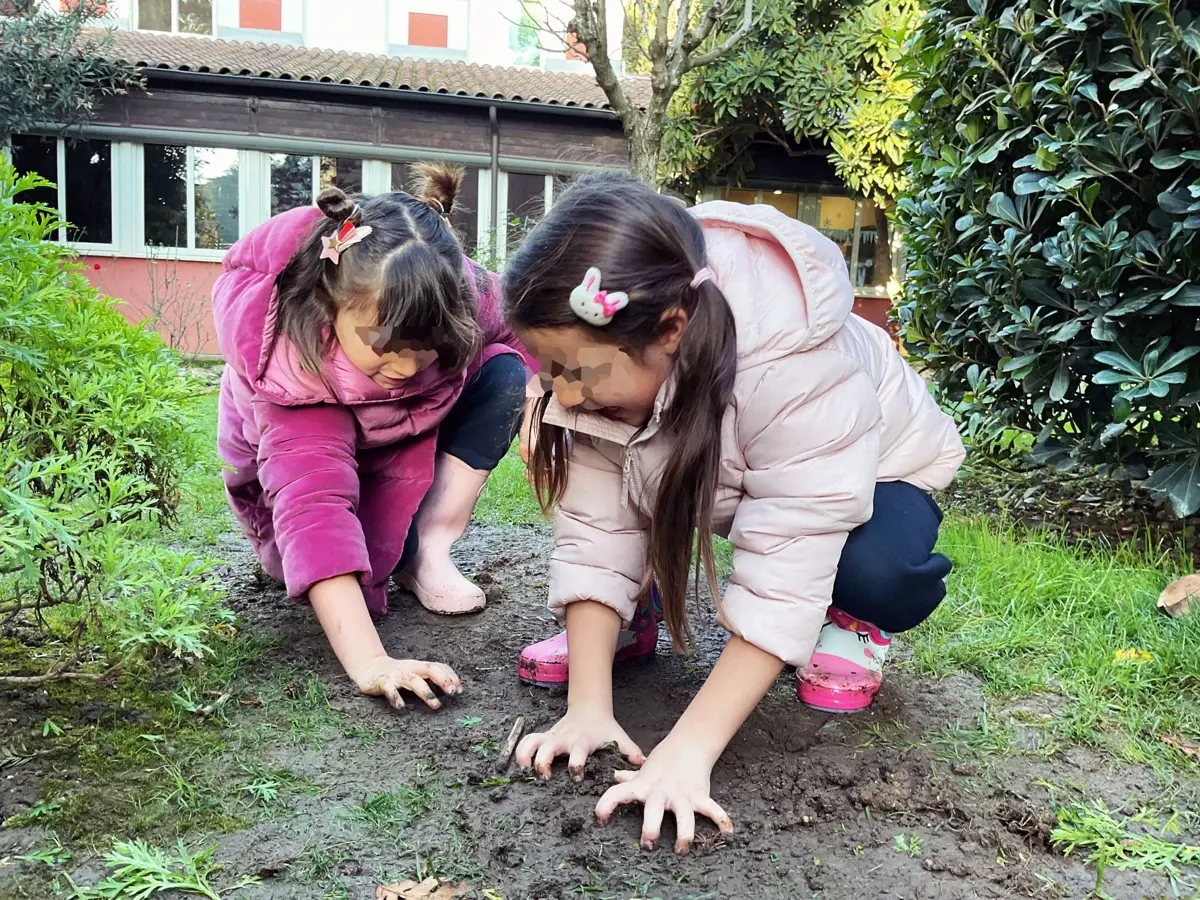
Time outdoors is an integral part of our children's day: we leave the classroom with intention, turning the garden into a place rich in stimuli where every corner invites discovery.
The school's outdoor spaces — extensive, well cared for and recently renovated — include sensory classrooms, learning panels and workshop areas designed for play, movement and exploration. The garden is not simply a place to unwind: it is a living environment where children grow with all their senses, developing curiosity, independence and awareness through direct, daily contact with nature.
Through Cubetto, a small wooden robot designed for young children, our pupils take their first steps into the world of coding in a natural, playful way. By playing with physical commands, they learn to build sequences, anticipate actions and solve small problems, developing logical and strategic thinking.
Working with Cubetto sparks curiosity, supports concentration and encourages cooperation between peers in a calm, stimulating setting: coding becomes a creative activity that helps children explore, reason and give concrete shape to their ideas.
In our art workshops, children freely explore different forms of expression such as drawing, painting and sculpture. These spaces, designed to nurture creativity, offer materials and tools that invite discovery, experimentation and the joy of making things with their own hands.
Through art, children refine their motor coordination, train the precision of their movements and develop greater body awareness. At the same time they learn to give shape and voice to their emotions and thoughts: art becomes a powerful expressive language that supports each child's emotional, imaginative and relational growth.
We engage children in a journey of spiritual education and active citizenship through the project "Seminiamo valori: crescere insieme con Fede e rispetto" ("Sowing values: growing together with faith and respect"). Inspired by the encyclicals "Fratelli tutti" and "Laudato si'" and aligned with the goals of the 2030 Agenda, the program helps our youngest learners develop a sense of care, respect and fellowship.
The journey unfolds in eight stages around three great themes: caring for the world, opening up to others and recognizing one another as brothers and sisters. Each stage ends with a moment in the chapel where children can reflect and share their thoughts, experiencing spirituality with simplicity and joy.
Through the Gordon method and the Maestro Libero method, children experience music as an engaging, natural experience that nurtures listening, creativity and connection. Activities develop musical sensitivity, rhythm and pitch in an atmosphere of play and free expression.
Children learn to listen actively, to recognize sounds, silences and melodies, and to respond with their bodies, voices and movement. Music thus becomes a privileged channel for cognitive, linguistic and emotional development, giving every child the chance to express themselves authentically, at their own pace and in their own way.
Lunchtime as a learning experience
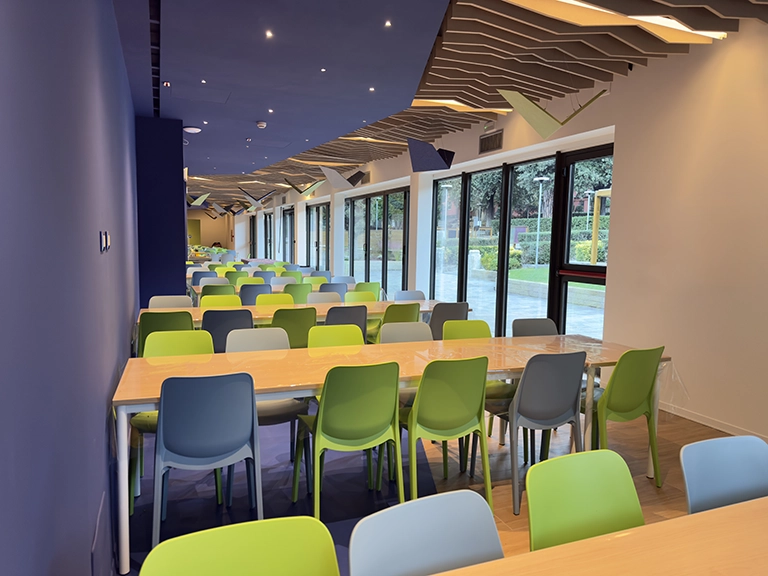
Every day, children enjoy meals prepared with care in our own kitchens, served in dedicated dining spaces around the school, with staff always present to supervise and foster a calm, respectful atmosphere.
Menus are balanced, seasonal and approved by dietitians and nutritionists, in line with healthy-eating guidelines for growing children: we favor fresh, organic and locally sourced products wherever possible. Alternative menus are available for medical, ethical or religious reasons, upon documented request from families.
The dining hall is also an educational workshop: here children learn respect for food, good posture at the table and the value of shared time. They are encouraged to try new foods, recognize flavors and talk together about what they eat — all in clean, well-organized spaces that guarantee safety, well-being and inclusion, so that every child feels welcomed and part of a community.
Sharing the journey with families
Each child's growth is followed and shared with families every step of the way: through careful, continuous observation, the building of a Portfolio, shared reflection and visual documentation. We monitor children's activities to assess their cognitive, social and emotional development, and we offer families these tools for dialogue, sharing progress and the experiences lived at school.
Documentation is not merely an assessment tool but a true bridge between school and home: it tells the story of progress, discoveries and emotions. It also builds a living record of each child's educational journey — one that children themselves, together with their educators, actively help to shape.
Choose the Marymount continuum
Istituto Marymount offers a complete educational journey, from Early Childhood all the way to High School.
Request information
Contact us — we'll get back to you as soon as possible!
Via Nomentana 355 · +39 06 8622571
Via Livorno 91 · +39 06 86225757